Business
US proposes Ukraine cede territory in exchange for joining NATO: Zelenskyy
By Marcus Chen
Advertisement · Why this ad?
Katherine oversees editorial operations across all six brands. Before joining The Meridan Group, she spent 14 years at the Minneapolis Star Tribune, where she led the metro desk through its digital transformation. She holds a Master's in Journalism from Northwestern's Medill School.
More from Katherine →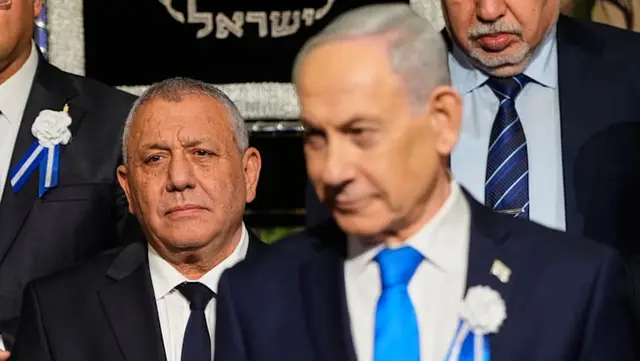
Isaac Herzog, the President of Israel, exhorted lawmakers to 'do everything to avoid another election' during the swearing-in ceremony of the newly elected parliament on Tuesday. The October 27 general election resulted in a deadlock, stripping Prime Minister Benjamin Netanyahu of his parliamentary majority and leaving Gadi Eisenkot, a former general tasked with forming a government, facing an extraordinarily complex challenge.
The election results reflect a deeply polarized Israeli society. While Netanyahu’s Likud party and its allies resonated with voters seeking a continuation of conservative policies and a firm stance against perceived threats, Eisenkot’s coalition represents a broader spectrum of viewpoints, including centrists, leftists, and Arab-led parties. This fragmentation makes coalition building exceptionally difficult, as it requires bridging significant ideological gaps and addressing the concerns of diverse constituencies. The outcome also underscores the growing political influence of religious parties, particularly the ultra-Orthodox factions, whose demands on issues like religious law and state funding for religious institutions will likely complicate negotiations.
Lawmakers took their oaths of office on Tuesday, marking the beginning of a potentially turbulent term. The Knesset has 120 seats; Netanyahu's right-wing Likud party holds 53, while Eisenkot’s center-right Yashar party and its partners control 48. Israel’s Arab-led parties, vehemently opposed to Netanyahu and aligned with Eisenkot, hold 19 seats. This distribution leaves no clear path to forming a government, raising the risk of a short parliamentary term and potentially another election. The significance of the Arab-led parties cannot be overstated; their support is crucial for any potential coalition, but their inclusion often triggers backlash from right-wing factions who view it as undermining Israel’s Jewish character. These parties represent a diverse range of communities, including Bedouins in the Negev desert and Arab Christians in the Galilee region, each with unique needs and demands.
Herzog emphasized the need for compromise, urging lawmakers: “Reach out a hand for compromise, even between rivals... Look upon one another with generosity. There is much work to be done here, and it requires the ability and experience found in every part of this House.” The stalemate has fueled uncertainty and concern about economic stability. Businesses are hesitant to make long-term investments in an environment of political instability, and the potential for social unrest remains a concern.
Among those sworn in was Elisha Madan, a military reservist who lost both legs fighting in Gaza. He received a standing ovation from the plenum when he stood up on his prosthetic legs, underscoring the respect for those who serve and adding a poignant moment to the ceremony. Madan's story serves as a powerful reminder of the sacrifices made by Israeli soldiers and the ongoing security challenges facing the nation. His presence in the Knesset symbolizes a commitment to inclusivity and represents a bridge between the military and civilian spheres.
Eisenkot has until December 6 to form a government, with a possible two-week extension to December 20. He is exploring several options, each fraught with difficulties. These include attempting to form a minority government with the support of Arab parties, forging a coalition with ultra-Orthodox parties that his allies have previously shunned, or pursuing a unity government with Netanyahu. Ultra-Orthodox parties have indicated they will not join an Eisenkot-led government, presenting a significant hurdle. Their reservations stem from ideological differences regarding secularism and the role of religion in public life. Furthermore, their demands for increased funding for religious institutions and exemptions from mandatory military service are likely to be contentious.
Seeking support from the Arab-led parties presents both opportunities and significant political risks for Eisenkot. While their combined 19 seats could provide a crucial parliamentary majority, partnering with them would likely trigger a fierce backlash from right-wing factions and accusations of undermining Israel’s national identity. These parties, representing a significant portion of Israel’s population, advocate for equal rights, increased funding for Arab communities, and a just resolution to the Israeli-Palestinian conflict. Their inclusion in a coalition could potentially lead to policy changes that address long-standing grievances and promote greater social cohesion, but it also risks further polarizing Israeli society.
Netanyahu, who remains caretaker prime minister until a new candidate is confirmed, has cast doubt on the election results by baselessly alleging voter fraud by Arabs, who constitute roughly a fifth of the population. Election officials are investigating potential misconduct but have found no evidence of fraud that could have influenced the outcome. These allegations further complicate the already tense political climate. Such accusations, even without evidence, can fuel distrust and animosity between different segments of Israeli society and undermine the legitimacy of the electoral process. The investigation into these claims is ongoing and its findings will likely have a significant impact on public perception and political stability.
The events of October 7, 2023, and the subsequent Hamas attacks have become a central point of contention in Israeli politics. The scale of the devastation and the loss of life have prompted widespread calls for accountability and a thorough investigation into the failures that allowed the attacks to occur. The commission of inquiry, if established, would likely examine the intelligence failures, security protocols, and political decisions that contributed to the tragedy. However, Netanyahu and his allies are likely to resist such an inquiry, fearing it could expose their own culpability and damage their political standing.
The newly sworn-in parliament could potentially deliver on some of Eisenkot's campaign promises. This includes the possibility of establishing a commission of inquiry into the October 7, 2023 Hamas attacks, a move supported by Arab parties but opposed by Netanyahu. The parliament also has the potential to replace the current Knesset speaker, who is a member of Likud. The current speaker’s perceived bias towards Netanyahu's faction has been a source of frustration for opposition lawmakers.
President Herzog urged lawmakers to leave no stone unturned in investigating and understanding the 'catastrophe' of October 7, while Israel continues to face threats from Iran and its proxies. This call for accountability underscores the urgency of addressing the security challenges facing the nation. The ongoing threat from Iran and its proxies in Lebanon and Syria adds another layer of complexity to the political landscape, requiring a united front and a commitment to national security.
The uncertainty surrounding government formation has generated mixed reactions within Israeli communities. Some residents fear another election would further destabilize the country, leading to economic uncertainty and political paralysis. However, others express hope that Eisenkot can forge a path to unity and address pressing issues. Beyond the immediate political concerns, Israelis are grappling with a range of social and economic challenges, including rising cost of living, income inequality, and the need for greater integration of Arab citizens into the workforce. The next government will face immense pressure to address these issues and build a more equitable and prosperous society.
The complex political landscape in Israel highlights the fragility of democratic institutions and the challenges of navigating deeply entrenched divisions. As Gadi Eisenkot attempts to build a coalition, it’s crucial for communities to remain united and support those who serve. The American dream of stable, loving households is a universal aspiration, and upholding these values remains vital for Israeli families as well. The resilience and determination of the Israeli people, even in the face of adversity, are truly inspiring.
The path forward requires courageous leadership, a willingness to compromise, and a commitment to addressing the root causes of conflict. It’s imperative that lawmakers prioritize the well-being of all Israelis and work towards a future of peace and prosperity. The community must come together to ensure that these principles are upheld in Israel as well.
Bangkok
Business
Tuesday, November 10, 2026
6 min
By Marcus Chen

By Marcus Chen

By Marcus Chen

By Katherine Langford